Introduction
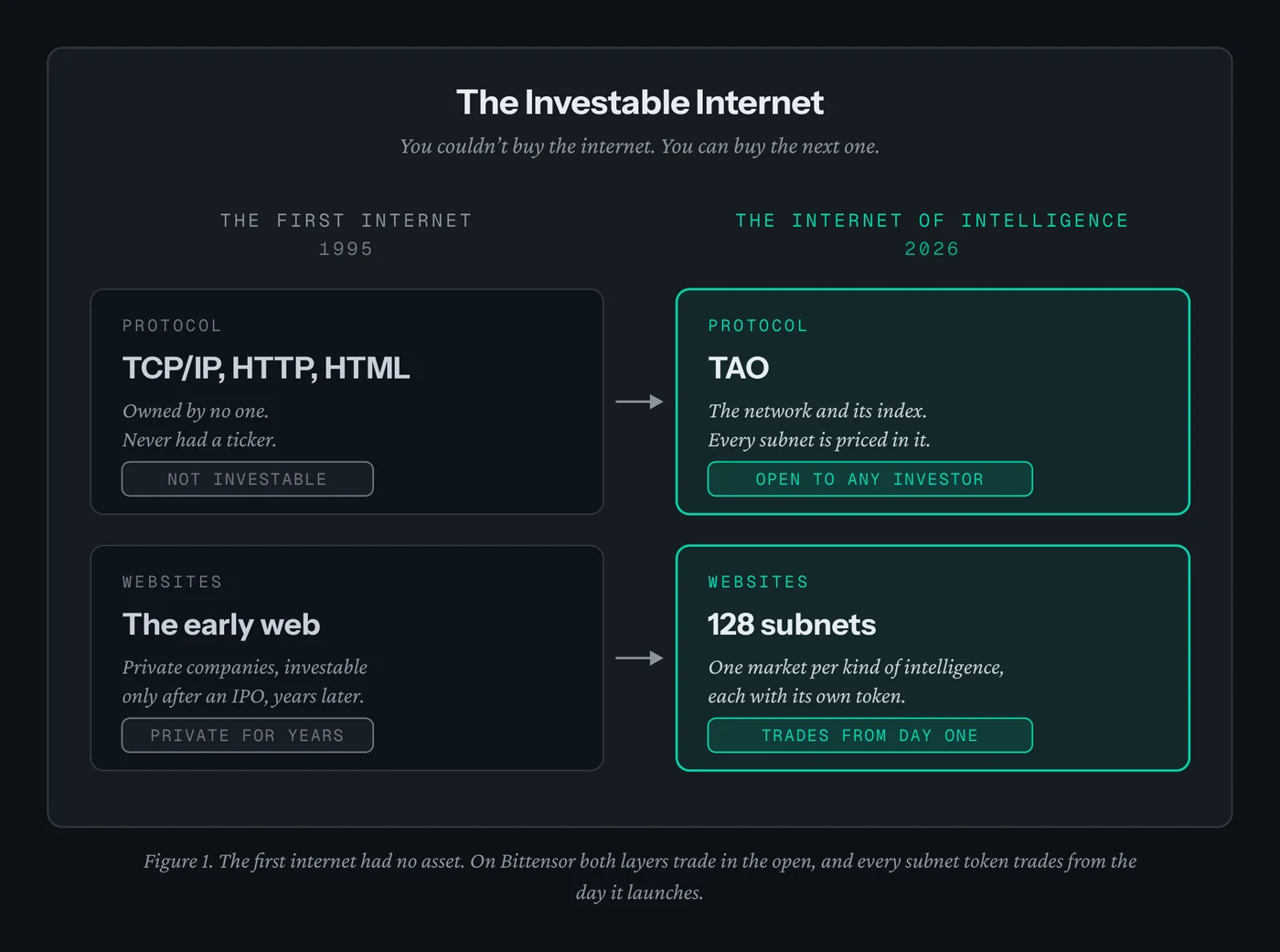
The internet became the most valuable network in history, and no investor, at any price, has ever owned a piece of it. TCP/IP and HTTP were public standards. They went on to carry most of the world’s commerce and communication, but none of the wealth they created stayed with the protocols. It went to the companies built on top, and the best of those stayed private for years.
Bittensor is the open protocol of the intelligence era, built to move intelligence rather than information, and this time the protocol itself can be owned. It has an asset. TAO is the network’s own currency, and every subnet on it, each one a market for a single kind of intelligence, trades against TAO from the day it launches. An investor in 1995 with perfect foresight still couldn’t have owned the protocols, or for several years the best companies built on them. On Bittensor both layers trade in the open, and every subnet token has traded from the day it launched.
In April we wrote that TAO would anchor an economy worth more than $1tn by 2030. Six months on, we think $1tn is the floor, not the ceiling. Anyone making a claim like that owes readers the arithmetic, and this paper is ours.
We published The Bittensor Thesis in March to explain how the network works and why we called it the most significant opportunity in crypto since Ethereum. This paper doesn’t repeat that case. It checks the case against what 2026 delivered and runs the result forward to 2030, and 2026 has only raised our conviction. Three things moved from argument to evidence this year. Intelligence began to trade like a commodity, with open models taking most of the volume on a large public AI gateway while prices kept falling. Bittensor began to earn, with network revenue reaching about $65mm a year by our estimates, a significant multiple of what it earned a year earlier. And the network assembled every layer of a frontier lab, then used it to turn an open base model into one that, by its builder’s account, matches frontier quality from 2025 at a fraction of the parameters and price. TAO itself trades about where it did a year ago, while in our view the network’s fundamentals and momentum have grown by an order of magnitude. None of that is in the price yet.
Commodity markets tend to end the same way. Producers compete their margins down to a normal return, and the money that lasts goes to whoever owns the scarce inputs and whoever runs the market where the good is graded and sold. Part One of this paper sets out what 2026 showed. Part Two runs those trends to 2030 and describes what they build, which could be one of the largest pools of compute ever assembled without an owner, and a market where software buys intelligence the way a building draws water, with the money running back to TAO. Part Three is the arithmetic. Section 11 lists what would have to happen for the number to be reached, and readers should hold us to that list.
Part one: What 2026 showed
1. Intelligence Became a Commodity
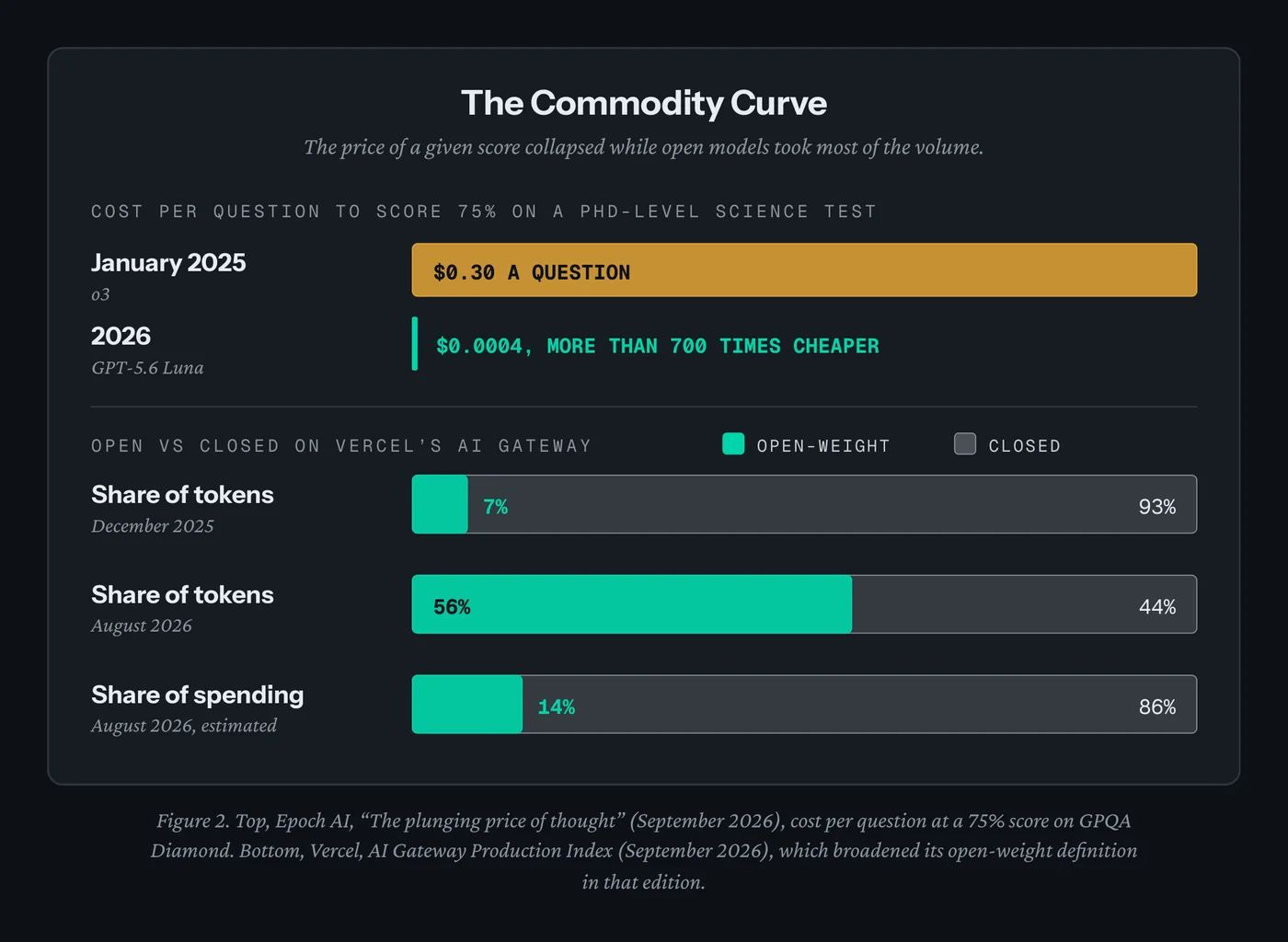
The first thing 2026 settled was the direction of the price of intelligence. In September Epoch AI estimated that the cost of reaching a given level of performance has fallen by about 13x a year since 2023, faster than DNA sequencing, computing or batteries ever got cheaper. A score on a benchmark of PhD-level science questions that cost about $0.30 a question in January 2025 cost about $0.0004 less than 18 months later, a drop Epoch puts at 725-fold. Epoch’s earlier work put the decline anywhere from 9x to 900x a year, depending on the task.
Open models do most of the work. Once anyone can download a model and run it, a closed model can’t charge much more for the same job than it costs to run the open one, and distillation keeps the gap short, because smaller models are trained on the outputs of bigger ones and a closed model’s API sells exactly those outputs. Every answer it sells helps train a cheaper competitor, and in September one leading U.S. lab alleged that seven Chinese labs had run more than 180mm exchanges through its models to train their own, about 150mm of them in one case. Asked on CNBC later that month whether that kind of copying was fair game, Jensen Huang said people strip Nvidia’s products down to their raw parts every day. “That’s called competition,” he said. Meanwhile the hardware keeps getting better. So we believe that by 2030 AGI-level intelligence will be effectively free at the margin, and running on the phone in your pocket.
The volume has already moved. Vercel, whose AI Gateway routes tens of trillions of tokens a month for production applications, reported in September that open-weight models handled 56% of its tokens in August, up from 7% in December and the first month they carried a majority. Because they cost so little per token they took only 14% of estimated spending, and closed models took the other 86% on 44% of the tokens. That’s how commodity markets usually turn. The cheap product takes the volume first, and the line between cheap and expensive moves up every time the cheap product gets better. Epoch now puts the best open models about four months behind the best closed ones, down from about a year in late 2024. The average price Vercel’s customers paid per token fell 23% in August alone, and when Vercel took apart an earlier monthly drop it found that at a fixed mix of models the price would have been essentially flat. The whole decline came from what customers chose to route. Buyers who move to the cheaper product as soon as it’s good enough are treating the good as interchangeable. Intelligence is a commodity now, and 2026 is the year the data made that plain. What enterprises, businesses and people are buying is intelligence per dollar, the most capability they can get for each unit they spend, and they’re becoming indifferent to which lab built the model or which generation it belongs to. The published figures probably understate the shift, too, since open weights run wherever their owners like and most of that inference never shows up in anyone’s index. Our partner Jason Calacanis has made the point on All-In more than once, calling them “dark tokens.”
None of that shrinks the market. In 1865 William Stanley Jevons noticed that more efficient steam engines had increased Britain’s coal consumption, because cheap power found uses expensive power never had. It’s known as the Jevons paradox, and intelligence may be the strongest case of it yet. A task gets automated the moment automating it is cheap enough. In the United States the share of adults who used AI on at least six days of the previous week rose from 8% in March to 19% in August, and more and more of the buying is done by software agents, which run all day and never reach a point where they’ve had enough.
The closest precedent is the printing press. Before it, copying knowledge was a craft, and a small, trained class decided what was reproduced and who could read it. Gutenberg didn’t write better books. He collapsed the cost of copying them, and by 1500 printers across Europe had turned out some 30,000 known editions. Information stopped being scarce, and within a century the world had been remade around it. Intelligence today sits roughly where information sat in 1450, and it’s more powerful than information ever was, because it acts. It turns an idea into software, into a business, into almost anything. We see TAO as the printing press of intelligence.
A unit price falling toward zero while volume climbs is how commodities behave, and the history of commodities is hard on producers. When buyers can’t tell one producer’s output from another’s, producers compete on cost until they earn about their cost of capital, and the profits that last go to the owners of scarce inputs and to the exchange where the good trades. Chicago grain is the textbook case. Until the 1850s, wheat there was sold by the sack and every lot had to be inspected by its buyer. In 1856 the Chicago Board of Trade began sorting wheat into standard grades, so grain of the same grade could be pooled in elevators and sold without anyone looking at it, and in 1865 the Board added standardized futures. Farmers went on earning ordinary returns. The Board became the place where the world’s grain was priced, and as part of CME Group its grain futures are still the global benchmark. Trading gathers where the liquidity already is, which is why a commodity rarely supports more than one or two big exchanges for long.
The AI industry already talks about intelligence as a fungible good. Jensen Huang calls data centers AI factories and measures them in tokens per watt and tokens per dollar, and as open models take share, what a closed lab can charge per token drifts toward the cost of the compute behind it. Intelligence still lacks what wheat got in 1856. A GPU hour is easy to measure. The quality of an answer or a forecast isn’t, and until strangers can check it without trusting each other, intelligence can’t trade the way graded wheat does. Whoever solves grading for intelligence will hold the position the Chicago Board of Trade held in grain. Bittensor was built around that problem, and no other network is.
Most of the capital in AI is betting the other way. The frontier labs are valued on the assumption that intelligence stays expensive enough to carry fat margins on the models themselves, while a market that trades intelligence wants the opposite, since every price cut adds volume. By 2030 model-makers will be farmers, earning an ordinary return on a commodity crop, and the lasting money will go to the owners of compute and to the market where intelligence changes hands.
2. The Market Chose Open
If intelligence is going to trade like a commodity, someone has to run the market, and 2026 made a strong case that it will be an open one.
The internet’s first winners mostly didn’t last. AOL spent the 1990s trying to own the way people got online and was worth more than $150bn at the top of the dot-com market, and Verizon bought it for $4.4bn in 2015. Sun Microsystems, which sold the servers the early web ran on and advertised itself with the line “the network is the computer,” reached a value of roughly $200bn in 2000, nine years before Oracle agreed to buy it for $7.4bn. The open standards underneath both companies are still running. AI is going through the same sequence. The closed frontier labs are sitting in the seats AOL and Sun once held, and the open standards outlasted both of them. They control access to the best models and much of the hardware that serves them, and the two most valuable are reported to be seeking valuations of more than $3tn between them.
Underneath them, an open layer of downloadable models, and of the networks that train and serve them, is growing fast.
Buyers moved first, and they moved on price, as the Vercel figures in Section 01 show. We doubt many of them switched for ideological reasons. For most of what a business needs, an open model is good enough and much cheaper.
Then June made the case on control. On June 12, a leading U.S. lab switched off its two newest models for every customer after an export-control directive from the U.S. Commerce Department. The directive was lifted on June 30 and access came back on July 1. We take no view here on whether the directive was right. But for almost three weeks, every person, business and country relying on those models learned that a supplier could be switched off by a decision they had no part in. Every open-weight model kept running, because once weights are published there’s nothing to recall. Governments outside the United States and China had worried about that kind of dependence for years. We believe few boards or governments that lived through June will stake a company or a country on a single closed model again. Huang put the risk in engineering terms in July, when he warned that a world running on one model has “one single point of attack, one single source of failure,” and in September Nvidia agreed to buy Hugging Face, the platform where most of the world’s open models are published, in a deal valued at $12.9bn. Read that as a statement about where the company selling hardware to everyone expects the volume to go.
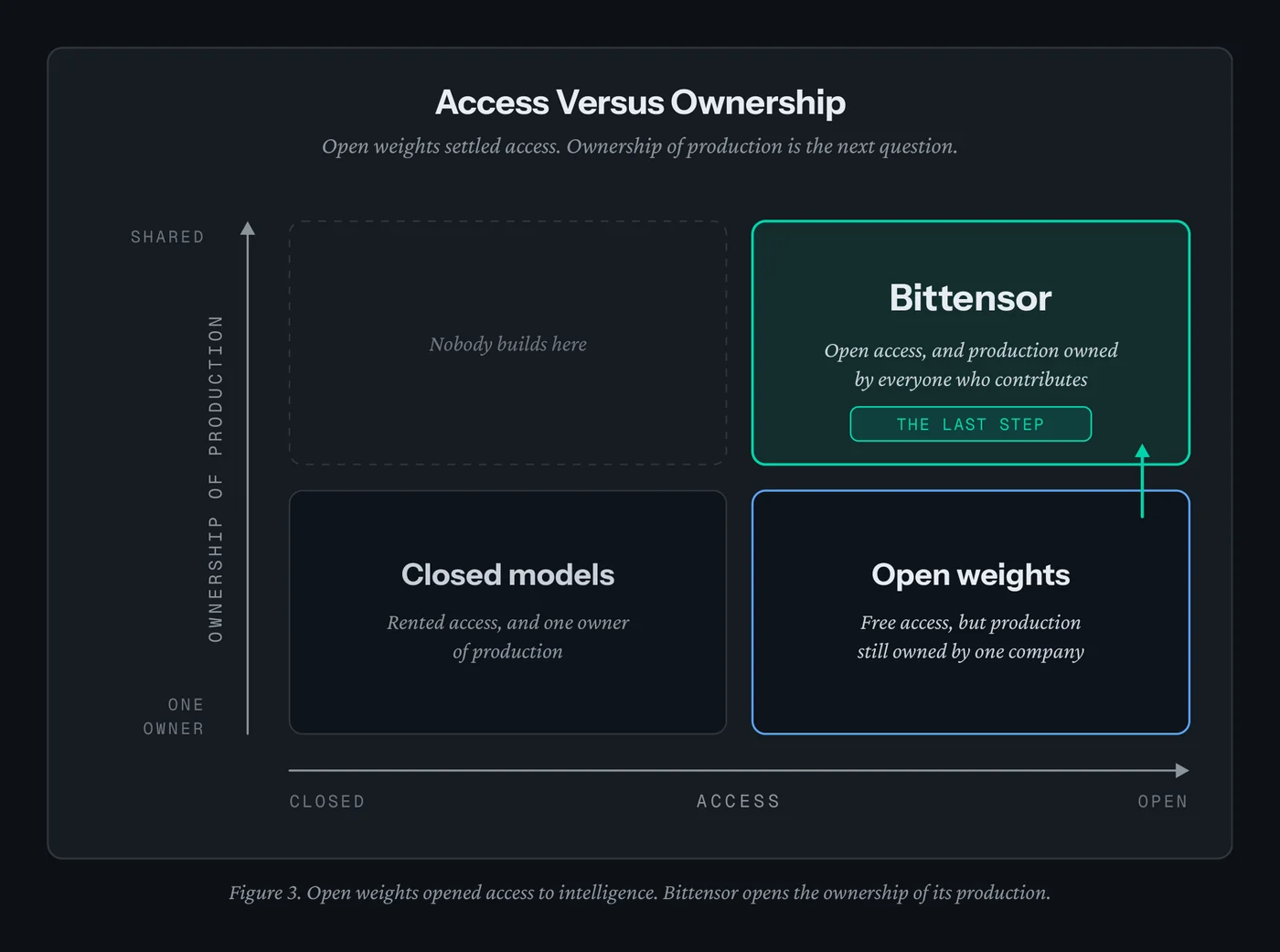
Open weights have largely settled the question of access, though they haven’t changed who produces the models. An open-weight model is still built and paid for by one company, and it gets released because releasing it suits that company’s strategy. Meta, DeepSeek, Moonshot and Nvidia all publish open weights for their own reasons, and any of them can stop. A good share of the Chinese wave is subsidized by investors who will eventually want a return, and it’s capped by export controls on the chips the next generation needs. When Moonshot’s Kimi K3 came out in July and placed third at launch on a widely followed independent index of model capability, behind only two closed models, it revived talk in Washington of sanctioning Chinese labs and of making U.S. companies liable for running their models. A model released by a single company can be withdrawn by that company, and its home government can restrict it. The compute, the data, the research and the rights to the output are as concentrated as they were before open weights took off.
Bittensor was built to open up that part. Anyone can bring compute or code to a subnet, and the network pays in tokens for whatever works, so the people who did the work end up owning a piece of what they built. Buyers are already settling the debate over whether AI should be open. The fight that decides the next decade is over who owns the production of intelligence, and Bittensor is built so that anyone can take part in it. That’s why the printing press comparison holds. The first press ended the scarcity of knowledge. This one ends the scarcity of intelligence, and anyone can hold a piece of it.
3. The Network Started Earning
Bittensor was designed to be that open market, and 2026 is the year it began to earn. The Bittensor Thesis covers the mechanics in detail, so we’ll keep them short.
People in the Bittensor community like to call Bitcoin the first subnet. It’s a joke, but an accurate one. Bitcoin sets a single task, which is to find a number whose hash falls below a difficulty target. Anyone can compete and check an answer instantly, and whoever finds one first gets paid in new bitcoin. With no company behind it, that loop built the largest computing network in history. Bittensor keeps the loop and lets anyone write the task. Each job runs as its own market, called a subnet. The subnet’s owner decides what the work is and how it gets scored, miners anywhere in the world compete to do it, validators score what comes back, and the chain pays the winners continuously in the subnet’s own token.
Scoring is where the difficulty lives. A hash either meets the target or it doesn’t, but the quality of a model’s answer, or which of two forecasts came closer, is a judgment call, and judgment calls can be gamed. Bittensor’s answer is Yuma Consensus. Validators score miners on a sliding scale, each validator’s scores count in proportion to the stake behind it, scores far from the consensus get clipped, and validators who keep disagreeing with the consensus earn less. That is the grading problem from Section 01, solved in software, and it’s why we believe Bittensor will become the exchange where intelligence is priced. The Chicago Board of Trade could pool wheat because an inspector’s grade let strangers trade it unseen. Yuma Consensus does the same job for an answer or a forecast. Many validators grade each piece of work, and because their stake and their earnings ride on agreeing with one another, the grade can be relied on without trusting any one of them. The test is whether buyers who never see the miners will pay for what they produce, and on 23 subnets they already do.
Capital moves through the same kind of market. Every subnet has a pool, built into the chain, that pairs its token with TAO, and the only way to buy a subnet’s token on the chain is to put TAO into that pool. The protocol issues new TAO every day and splits it among subnets according to the market price of their tokens. A subnet that attracts capital gets more of the new TAO and can pay for better work. One that bleeds capital gets starved, and if the bleeding goes on long enough, it loses its slot to a new team. Think of it as a venture fund that rebalances all day long, with the market doing the partners’ job. For a founder the difference shows up in the workforce. A company out of Y Combinator raises a seed round and spends most of it on hiring. A subnet founder writes an incentive, and once its emissions are switched on, engineers and GPUs from around the world compete to do the work.
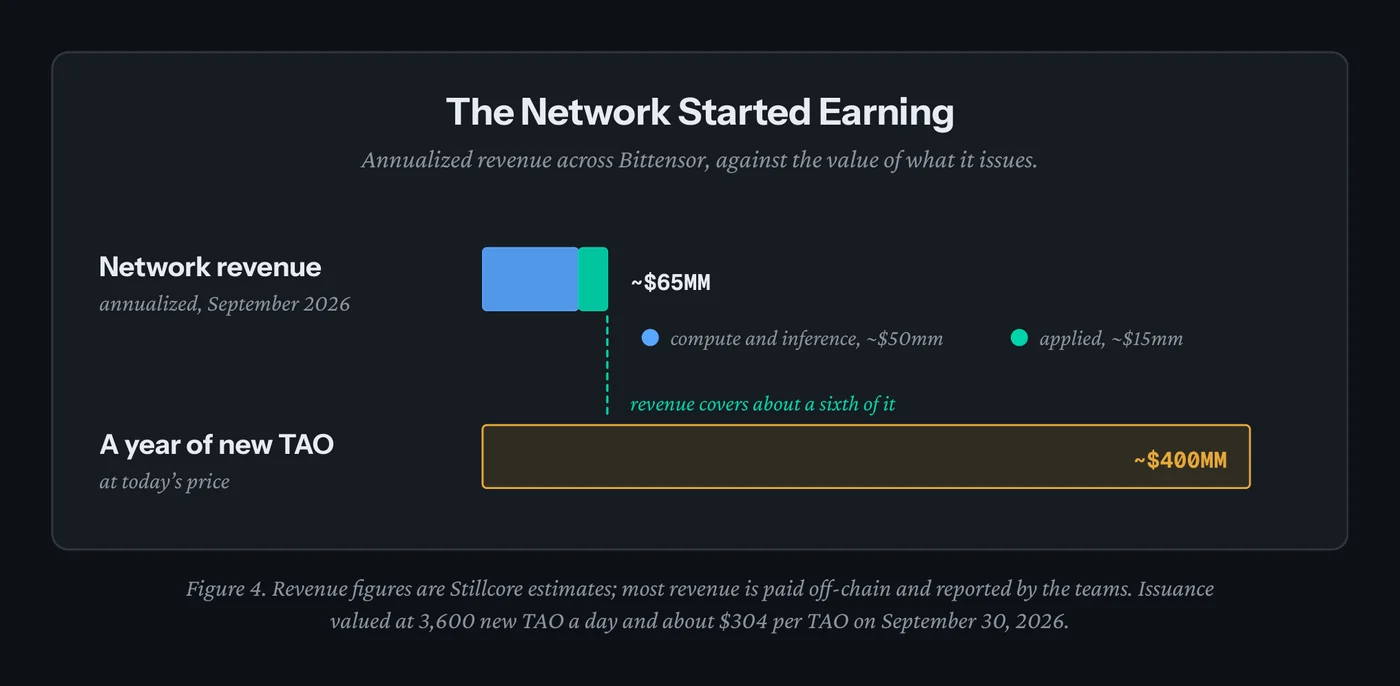
For most of the network’s life that machinery produced research more than revenue. That changed over the past 12 months. By our estimates, compute and inference subnets now bring in about $50mm a year and applied subnets about $15mm, a significant multiple of what the whole network earned 12 months ago. Estimates vary widely, because most of this revenue is paid off-chain and reported by the teams themselves. Const, Bittensor’s co-founder, told the audience at the Exploit Summit in Montreal in September that 23 of its 128 subnets now have paying customers. Chutes, which serves the leading open-weight models to developers at a fraction of centralized prices, had about 800,000 registered users by the figures Const showed at Exploit. Targon runs confidential compute and co-published a white paper on it with Intel. Hippius runs storage that customers use outside the network. And by July two subnets reported earning enough from customers to cover everything the chain paid their miners, which is the first test of whether a subnet can stand on its own.
That $65mm still covers only about 1/6th of the value of the TAO the network issues each year. The protocol is meant to subsidize supply before demand arrives, and the subsidy shrinks on a fixed schedule. Revenue has no schedule. Its growth is the part of the case we’re betting on, and the number we’d tell anyone to watch most closely.
The rules changed this year as well. In May the protocol stopped minting free tokens to a subnet’s owner at registration and began tying ownership of a mature subnet to locked stake, so a large enough locked position can take it over. In June it began splitting new TAO by the market price of each subnet’s token, with a penalty for subnets that hold back their miners’ rewards. At Exploit, Const described the next step, which he expects in early 2027. The network will measure how much money each subnet draws from outside, from buyers on other chains and from purchases of its services, and make that one of the inputs that decide where new TAO goes. If it ships as described, the subsidy will start to follow the customers.
4. The Frontier Lab Took Shape
A frontier AI lab needs somewhere to keep and move data, compute to train and serve models, a way to train them and products that put them to use. Bittensor now has subnets working at every one of those stages.
On the infrastructure side, Hippius (SN75) runs S3-compatible storage, while Beam (SN105) moves large datasets across a decentralized bandwidth network. Compute and inference is the most developed layer. Chutes (SN64) serves open models, Targon (SN4) runs confidential compute, Lium (SN51) rents out GPUs, Engy (SN53) serves open models and says it attaches a cryptographic proof that each answer was computed correctly, and Actual (SN95) pools everyday machines into a single inference computer. Training is thinner but moving, with IOTA (SN9) pre-training on single GPUs connected over the open internet, Teutonic (SN3) running a continuous contest on a 110bn-parameter model, and Affine (SN120) improving open models after pre-training through head-to-head contests. At the application end, Score (SN44) turns ordinary cameras into computer vision for businesses and Minos (SN107) does genomic variant calling aimed at clinical use, with others working on software security (RedTeam, SN61), video compression (Vidaio, SN85), forecasting (Synth, SN50) and alignment data (Aurelius, SN37).
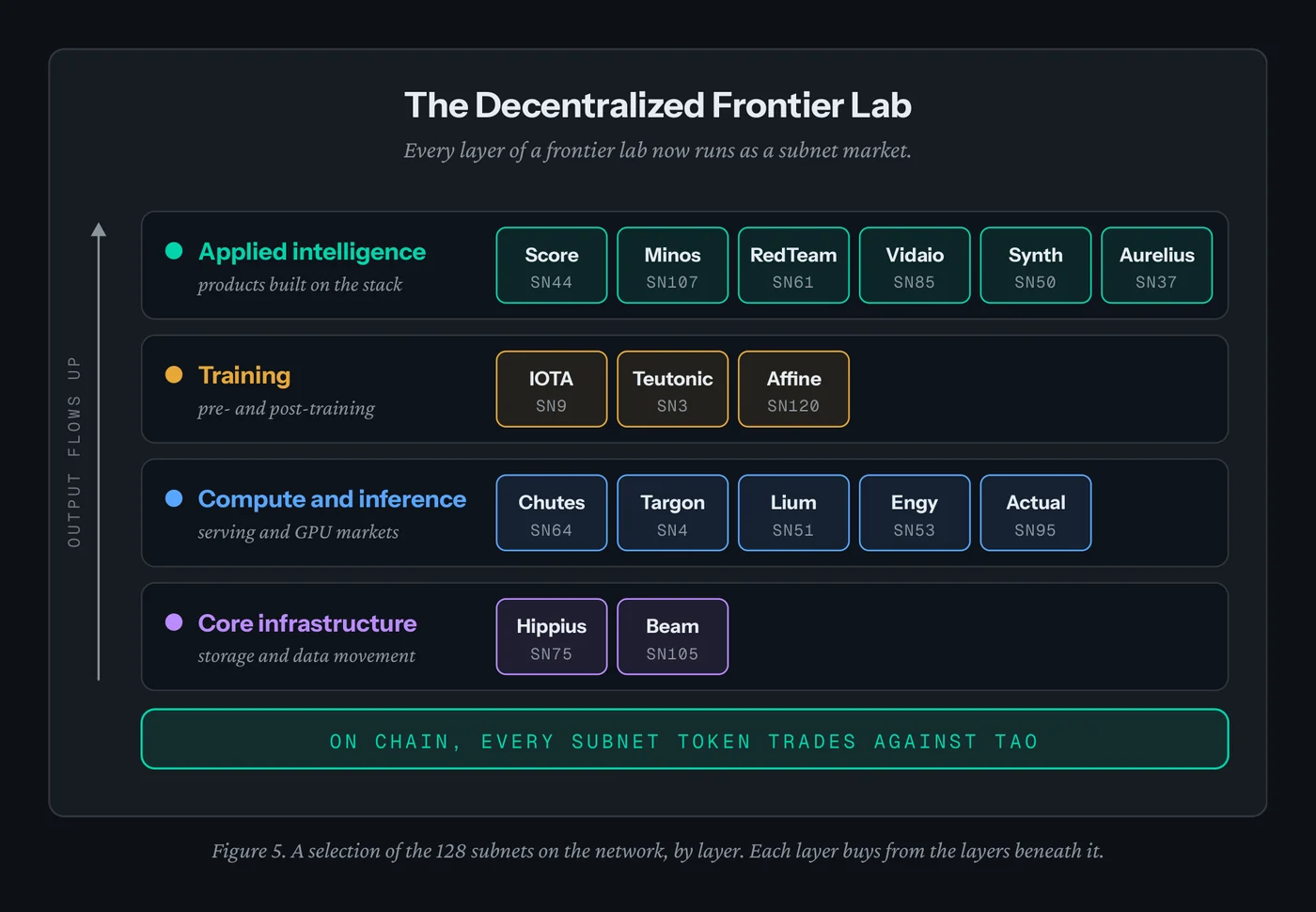
The subnets also trade with each other. Minos keeps its genomic data on Hippius, and applications buy inference from Chutes rather than paying a hyperscaler. A layer that runs on a cheaper layer below it can charge less for its own service without giving up margin, and because each layer uses the output of the ones beneath it, the savings stack up as you move up. A closed lab has to own and fund every one of these layers itself, all on one balance sheet. On Bittensor each layer is funded by its own market, competes for its own customers and sells to every other subnet on the same terms, a cost structure no single company can copy.
How far this goes by 2030 depends mostly on training. Selling compute and serving other people’s open models is already a big business, and it produces most of the network’s revenue today, but Bittensor only becomes a frontier lab if it can produce competitive models of its own. In 2026 the first ones arrived. In the first quarter the network produced Covenant-72B, a 72bn-parameter model trained by at least 70 independent contributors, with benchmark results in the range of Meta’s Llama 2 70B, a model of similar size trained in 2023 inside one company’s data centers. The team behind it left the network in April, and its subnet now runs Teutonic. In June IOTA ran a 100bn-parameter model across five data centers on single A100 GPUs at about 65% of the training speed of an equivalent data center, and a complete replica of the model, 16 separately rented A100s, cost about $20 an hour. Macrocosmos, which runs IOTA, says it ran as a proof of viability rather than to a finished model, and in September it showed a 16bn-parameter run on a mix of gaming and data-center cards. Teutonic’s second model, a 110bn-parameter run that is still training, is what Const calls the largest decentralized model yet.
The result that matters most came at Exploit. Const stepped back from running the Opentensor Foundation to build Affine, a subnet that sets miners against one another to improve open models after pre-training, because he wanted to prove the network could train frontier models and not only serve them. In September he showed its first model. It started from an open model released by a Chinese lab, and everything after that was done on Bittensor, on infrastructure from Hippius, Lium, Targon and Engy, by what he called “an unorganized group of individuals across the globe” who compete for the same reward. Const says that on his team’s own scoring it would sit on the frontier of a widely followed independent index for a model of its size, 36bn parameters with 3bn active, and that it matches a leading closed model from 2025 across a combined set of benchmarks. Those are the builder’s own figures, and we’d like to see them replicated. Even discounted, it changes what the network is. A network whose contributors are strangers and adversaries took an open model and trained it to frontier quality from 2025, at a fraction of the parameters and price, on infrastructure the network also runs. No company could have hired that team.
The same talk announced the piece that turns the stack into an economy. The subnets already sell to one another, but each keeps its own books, the way a cloud provider sells prepaid credits. Gamma tokens, which Const expects to release in 2027, will put those credits on the chain under one standard. A buyer burns a subnet’s own token and receives credits worth a fixed number of dollars, set by a price oracle, that can only be spent on that subnet’s service, so an hour on Lium or inference on Chutes becomes a token that can be bought, held, transferred and bridged to other chains. A subnet will be able to direct part of its emissions to buying other subnets’ credits, the way a startup spends most of its raise on compute, and anyone holding crypto on another chain, including an AI agent, will be able to rent a GPU or buy inference without a website, an account or an email address. In effect it gives the network a stable unit of account for compute, which a volatile token can’t be. When it ships, the frontier lab gets a common currency, every subnet’s customers include every other subnet, and any agent on any connected chain can buy intelligence from Bittensor without asking anyone’s permission.
We’ll be plain about the gap. When we wrote The Bittensor Thesis we put decentralized training’s effective throughput at about 300 times below the largest centralized clusters, and we estimated that the compute available to decentralized training was growing about 20x a year, about four times as fast as centralized infrastructure. If those rates held, the gap would shrink by a factor of about four a year and close in a little over four years, somewhere around 2030. We don’t count on that in our base case. It’s a hard engineering problem that could fail, so we treat it as an option on top. If it works, and 2026 says it can, every model becomes a commodity, and Bittensor sits at the source of the world’s supply of intelligence.
There’s an older argument for why it might. In 1997 Eric Raymond described two ways to build software, the cathedral, designed by a small group and released when finished, and the bazaar, built in public by whoever wanted to contribute, and Linux came out of the bazaar. In September OpenAI said that about 10,000 agents running an unreleased model, working in groups and exchanging millions of messages, had produced a proof on the Navier-Stokes problem in about 88 hours. It has been checked by OpenAI’s own system but not yet independently verified, and mathematicians have only started on it. Whatever they conclude, the result came from a large group of cooperating agents, and OpenAI ran that group inside a single company. A network of specialized subnets that call on one another and pay their contributors is the same idea, run in the open.
Part two: What it builds by 2030
5. The Machine the Incentive Builds
Bitcoin ran on a handful of personal computers in 2009. By 2025 its miners were computing more than 1,000 exahashes a second and drawing about as much electricity as a mid-sized country, and no company had planned or paid for any of it. The mechanism is simple enough. Miners keep adding machines until the last one added earns just enough to cover its costs, so the size of the network follows the dollar value of the reward. Hashing doesn’t produce intelligence, and Bitcoin’s machine exists only to secure a ledger, but it shows better than anything else how much hardware a permanent incentive can pull together without an owner.
Bittensor’s machine grows by the same arithmetic, with two advantages. Its miners are paid in new tokens, and on subnets with customers the revenue goes into buying those same tokens, so the reward grows with the business. And the network can use almost any hardware the moment it exists, so data-center GPUs rented through Lium work alongside the gaming cards IOTA trains on and the home machines Actual pools together, while a data center has to be financed and built before it produces anything.
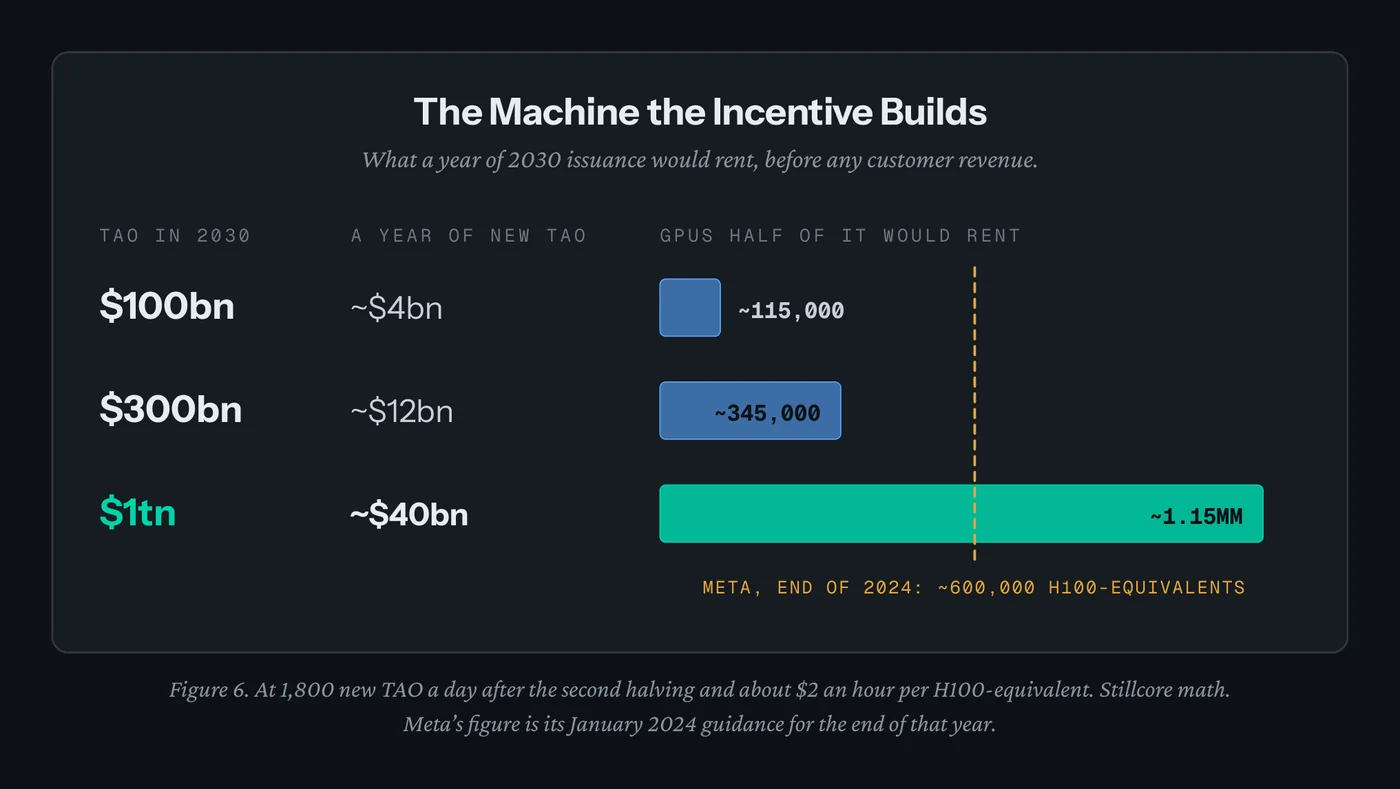
That makes it possible to estimate how big the machine gets by 2030 from the value of issuance alone. By then the second halving, which the current issuance rate puts at around the end of 2029, will have cut new issuance to about 1,800 TAO a day, on a supply of roughly 16mm. Figure 6 shows what a year of that issuance would be worth at three values for TAO, and how many H100-class GPUs half of it would rent at about $2 an hour.
At $1tn, issuance alone would rent more than 1mm H100-class GPUs for a year, before counting a dollar of customer revenue, and in the revenue path in Section 10, half of $25bn would rent roughly another 700,000. For scale, Meta said in January 2024 that it expected to end that year with the equivalent of about 600,000 H100s. These figures also assume today’s hardware. If price-performance keeps doubling every 2 to 3 years, the same dollars will buy several times as much compute by 2030. The biggest labs may be larger still by then, but at $1tn Bittensor’s machine would rank among the largest in the world, with no owner and no balance sheet behind it, and it would grow automatically every time TAO rose.
The incentive works on people, too. At past highs, top miners have earned tens of thousands of dollars a day, paid only for what they produced. An engineer in Lagos or Manila can be as good as anyone in San Francisco and still be shut out of the jobs and capital that would pay for it. Bittensor doesn’t ask where a miner lives or went to school, and it may turn into one of the largest talent markets ever opened. A country with stranded power or idle chips can use it to export intelligence, the way some countries already export hashrate.
6. From Pyramid to Subnet
In 1937 Ronald Coase set out to explain why firms exist at all, given that markets are supposed to be good at allocating resources. His answer was transaction costs. Finding someone to do a job, agreeing on terms, checking the work and paying for it all cost money, and when those costs run high it’s cheaper to hire people and manage them than to contract with strangers.
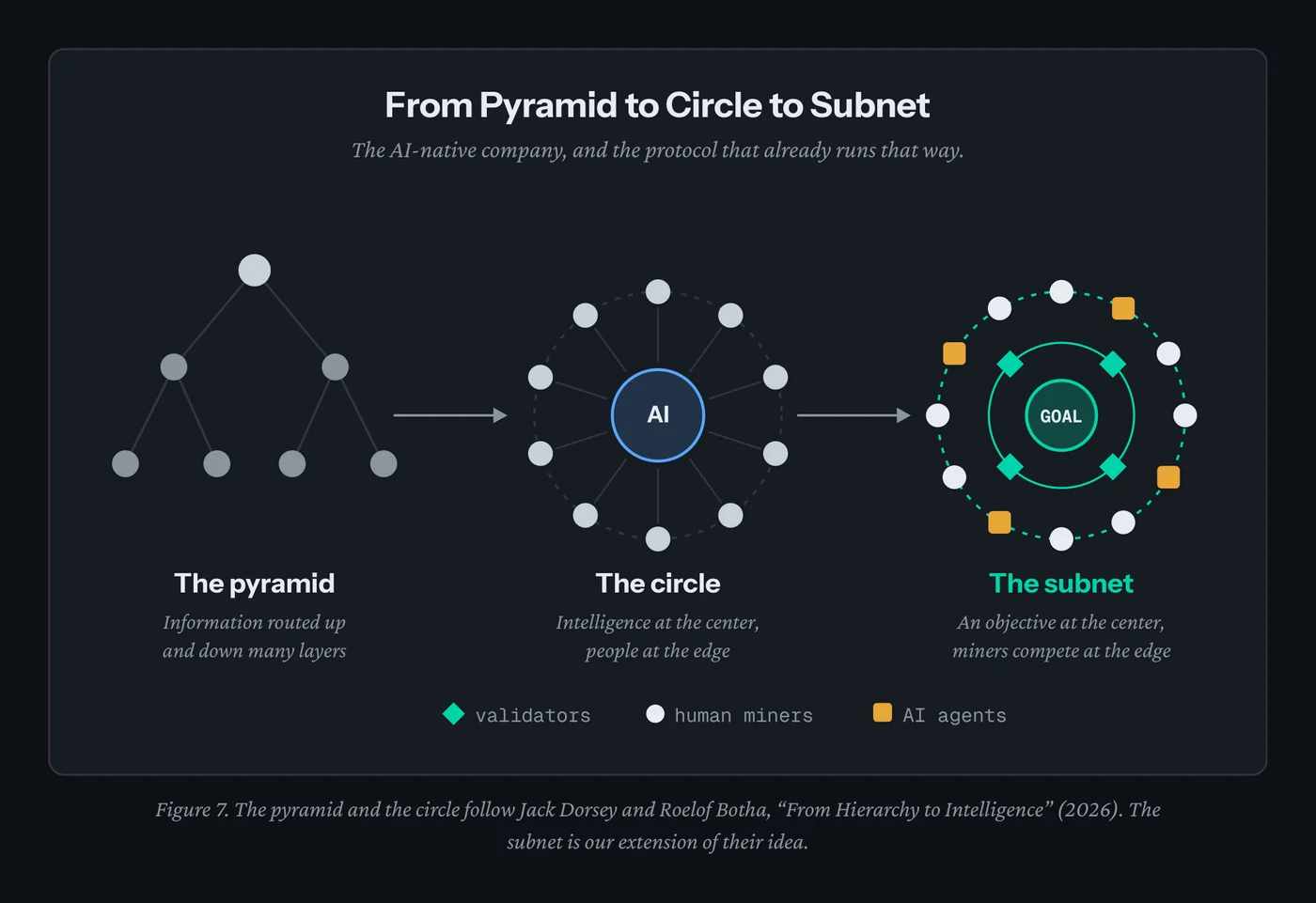
Jack Dorsey and Roelof Botha came at the same problem from the other end in March, in an essay called “From Hierarchy to Intelligence.” Since the Roman army, they argue, organizations have used layers of managers mainly to pass information up and down and to keep everyone aligned, and every extra layer slows things down. AI can now do most of that routing. The company they describe puts intelligence at the center and people at the edge, where the work gets done, and steers by revenue on the view that “money is the most honest signal in the world.” Dorsey has started rebuilding Block around the idea, weeks after cutting about 40% of its staff.
A subnet goes a step further and drops the company altogether, which takes out most of the costs Coase was describing. Registration is open, so finding workers costs nothing. The incentive mechanism is the contract. Validators check the work and the chain pays for it, while miners, more and more of them AI, compete at the edge and get paid for results. Nobody in the middle passes anything along, and resources follow the money, the same signal Dorsey and Botha picked. The main advantage of size used to be the ability to coordinate thousands of people toward one goal. A protocol can now do that for thousands of strangers at almost no cost, which lets a subnet compete with a company many times its size in any category where output can be measured. The costs that survive are the ones grading can’t reach. Where the work is hard to score, as with judgment, taste or trust, the firm keeps its advantage, which is why the categories that move first are the ones with a clear score.
Score shows how that works in practice. Its platform handles routine computer vision with a base model and sends the hard cases, like unusual lighting or rare objects, to the subnet’s miners, who compete to extend the model’s coverage. Each customer deployment turns up new hard cases, and each one the miners resolve improves the product for the next customer, while a conventional competitor improves only as fast as it can hire engineers and buy labeled data.
Most companies will never become subnets, just as most companies aren’t software businesses even though all of them run on software. We believe subnets will become the cheapest producers in category after category, and the largest companies will buy from them the way they buy from the cloud today. The first to see it will launch subnets of their own.
7. Intelligence on Tap
The biggest buyers of compute still buy it the way utilities used to buy power plants, years in advance and in enormous amounts. OpenAI’s reported agreement to buy about $300bn of computing capacity from Oracle over five years is the best-known example. Contracts like that made sense while capacity was scarce and reserving it was the only way to be sure of having it. Nobody buys water that way. You open a tap when you need it and pay for what you use, at a price the system sets.
Jensen Huang reached for the same comparison at the All-In Summit in September. Closed models work terrifically, he said, and he thinks of them as “kind of like bottled water.” Water itself is free, he went on, and you use the right water in the right places, the same as with electricity or any other commodity, so the world needs both. We’d take his analogy further than he did. Bottled water is a good business and probably always will be (on Vercel’s gateway, closed models still took 86% of August’s spending on 44% of the tokens), but the bigger business is the utility that meters water to every building. Bittensor is building that utility for intelligence, and the meter is where the lasting money is.
Electricity made this change within living memory. For most of the twentieth century, American power came from vertically integrated utilities that sold it at regulated prices. Starting in the 1990s, wholesale markets began pricing power in real time, and across much of the country electricity now clears every few minutes at the cost of the last plant needed to meet demand. Compute today looks like power before that change, sold on long contracts by a few large suppliers at prices set by negotiation.
Bittensor already works like a wholesale market for intelligence. Miners buy and run their own machines, so the network carries almost no fixed costs. Competition among them sets the price of each unit of work. The network can also use hardware a centralized cloud can’t use economically, and it pays the miners who do the work on-chain, in their subnet’s own token. We think the buyers that matter most by 2030 will be AI agents. An agent needs a market it can join without a contract or a sales call, one that quotes a price and takes payment in software.
None of this makes Bittensor a threat to the frontier labs or the data-center builders. Capacity bought years ahead needs somewhere to sell the hours it doesn’t use, and frontier models need cheaper models underneath them for the routine work customers won’t pay frontier prices for. Many in the industry now expect enterprises to split their work that way and keep frontier models for a narrow band of high-value problems, and the Vercel figures show the split is already under way. If it holds, some of the capacity built for the frontier will sit idle and look for buyers, and spot markets are where idle capacity goes. If decentralized training reaches the frontier around 2030, as Section 04 allows it might, the split disappears and every model becomes something the tap can deliver.
8. The Mosaic
Recursive self-improvement is a system that gets better at getting better. The curve bends when the thing doing the improving is itself improving, and on Bittensor the loop has started to close. The subnets are each other’s customers, so every gain one of them makes lowers the cost of the next. Const described the pipeline at Exploit. A pre-training subnet builds a base model, post-training subnets improve it and inference subnets serve it, and one post-training subnet already lets a model do the grading, so the network’s own output judges the network’s own work. He called it self-referential recursive improvement, and it runs in the open.
The same loop works at the level of a single miner. An AI agent that mines a subnet and earns more can buy more compute and get better at earning. Our bet is that by 2030 many more agents than people will be mining, running and launching subnets, and that starting a subnet will cost about what a website costs. One day there may be as many subnets as there are websites.
That changes what superintelligence might look like. We think it’s more likely to arrive as a mosaic of specialized intelligences working together than as a single model in a single lab. OpenAI’s 10,000 agents in Section 04 were a small version of that mosaic, run inside one company. Bittensor is the same idea with the walls removed, open to anyone and paid by a protocol, and it’s already assembling itself subnet by subnet.
By 2030, AGI-level models, humanoid robots, fusion and much else may be arriving at once. In a world that abundant, what stays scarce is whatever has a fixed supply. TAO is capped at 21mm, and it’s built to turn intelligence into a market.
9. Where the Value Lands
Follow the money on the network and it ends up in TAO, because on the chain every subnet token trades only against TAO. Anyone who buys a subnet’s token there, whether a customer, a trader, a fund or the subnet’s own team, has to put TAO into the pool that pairs the two. A subnet with revenue has its own reason to buy its token, since the token is what it pays miners with and a more valuable token attracts better work, so teams use revenue to pay their costs and to buy their own tokens on the market and burn them, and each purchase leaves TAO in the pool. Registering a subnet costs TAO, and staking into one commits TAO to its pool. Revenue and speculation on every subnet end up as demand for TAO, and so does every new subnet. TAO is the index of the entire economy Bittensor is building, although it gives holders no legal claim on the subnets themselves.
Gamma tokens would add a route that runs through usage rather than speculation. Credits can only be created by burning a subnet’s token, and an outside buyer gets there by bridging dollars in, buying TAO, buying the subnet’s token with it and burning that token, all in one transaction, as it was described at Exploit. The TAO the buyer spends goes into the subnet’s pool, and the burned tokens are gone for good, which in effect is a continuous buy and burn on every subnet that sells credits. When a subnet pays for other subnets’ credits out of its own emissions, it sells some of its own token to do it, so the net effect on any one pool depends on the mix. The rules haven’t been published, so we don’t count any of this in our numbers. But it points the network’s revenue at the same pools its speculation already runs through.
Supply is easier to pin down. Daily issuance was 7,200 TAO until the first halving on December 15, 2025, and runs at about 3,600 now. At the current rate the second halving comes around the end of 2029 and cuts issuance to about 1,800 a day, a 75% drop in four years, with about 16.4mm TAO issued by the end of 2030 against a hard cap of 21mm. And most of it is committed on chain. Of the roughly 11.6mm TAO issued so far, chain data show about 5.5mm staked on the root network and about 2mm in subnet pools, where it backs the subnet tokens, which leaves about 4.1mm, some 35%, unstaked. Bitcoin went from about $13 to more than $1,000 in 2013, the year after its first halving. TAO’s own first halving hasn’t done anything comparable so far, and we wouldn’t expect a supply cut to reprice anything on its own.
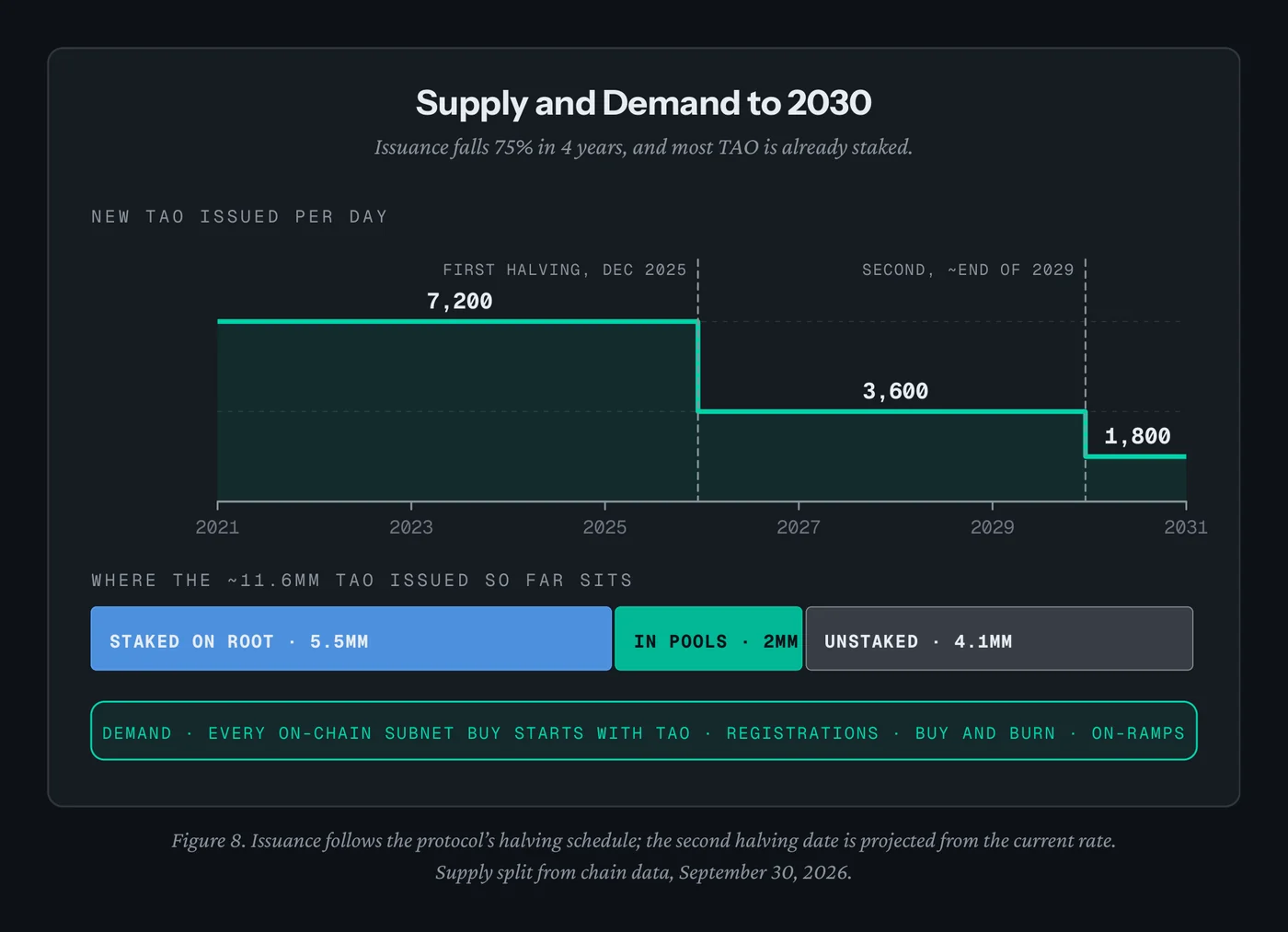
Then there’s demand. Ethereum had a demand shock in 2016 and 2017, when a wave of projects raised money in ETH and anyone who wanted in had to buy ETH first. On Bittensor the same pull is part of the design rather than a fundraising fashion, which is why our partner Mark Jeffrey calls TAO “the coin of the realm.” You need it to take part. Every purchase of a subnet token on the chain starts with TAO, and so does every new subnet registration, with 256 slots on the roadmap against 128 today. The on-ramps for outside money are being built now. Wormhole connected TAO to Solana in May, OKX listed TAO for spot trading in June, and since July Kraken has listed six subnet tokens for trading against the dollar. Grayscale has applied to turn its Bittensor trust into a U.S. exchange-traded product, and that application is pending.
New buyers also change who holds TAO, and that changes how it trades. We think a lot of today’s float sits with holders who treat TAO as a leveraged bet on Bitcoin and sell it hardest when Bitcoin falls, which is why TAO still moves with the crypto cycle more than with anything the network does. Staking, pool depth, subnet registrations and exchange-traded products all move TAO from traders to holders who tend to keep it, and we expect TAO’s sensitivity to Bitcoin to fade as that happens.
A copy of Bittensor would struggle for the same reason commodity exchanges consolidate. Thousands of miners and validators have spent years learning to beat each other on this network, and none of that experience moves to a fork. The chain runs its own exchange with deep liquidity, and its subnets buy from each other, so each new one makes the others more useful. It also pays out one of the largest steady funding streams in open-source AI, and it launched fairly in 2021, with no premine and no allocation to venture investors, which no later competitor can copy. The code is open source and anyone can fork it, but a fork would start with almost none of this.
The two sides feed each other. A higher TAO price draws in more hardware and talent, better products earn more revenue, and that revenue buys tokens against TAO. By 2030 daily issuance is scheduled to be 1/4 of what it was in 2025.
Part three: The arithmetic
10. The Road to $1tn
TAO traded at about $304 on September 30, about 40% of the all-time high of $757.60 it set in March 2024, when the network had 32 subnets and almost no revenue. It now has 128 subnets and about $65mm of annualized revenue by our estimate, with 256 slots on the roadmap, and the price has spent most of the time since moving with Bitcoin. The network’s growth hasn’t shown up in it yet.
Measured against the assets it gets compared with, TAO is small. It is worth about 1/500th of Bitcoin, and about 1/1,000th of the two most valuable private AI labs at the valuations they’re reported to be seeking. Ethereum, its nearest comparable in crypto, is worth more than 90 times as much, and Nvidia about 1,600 times as much.
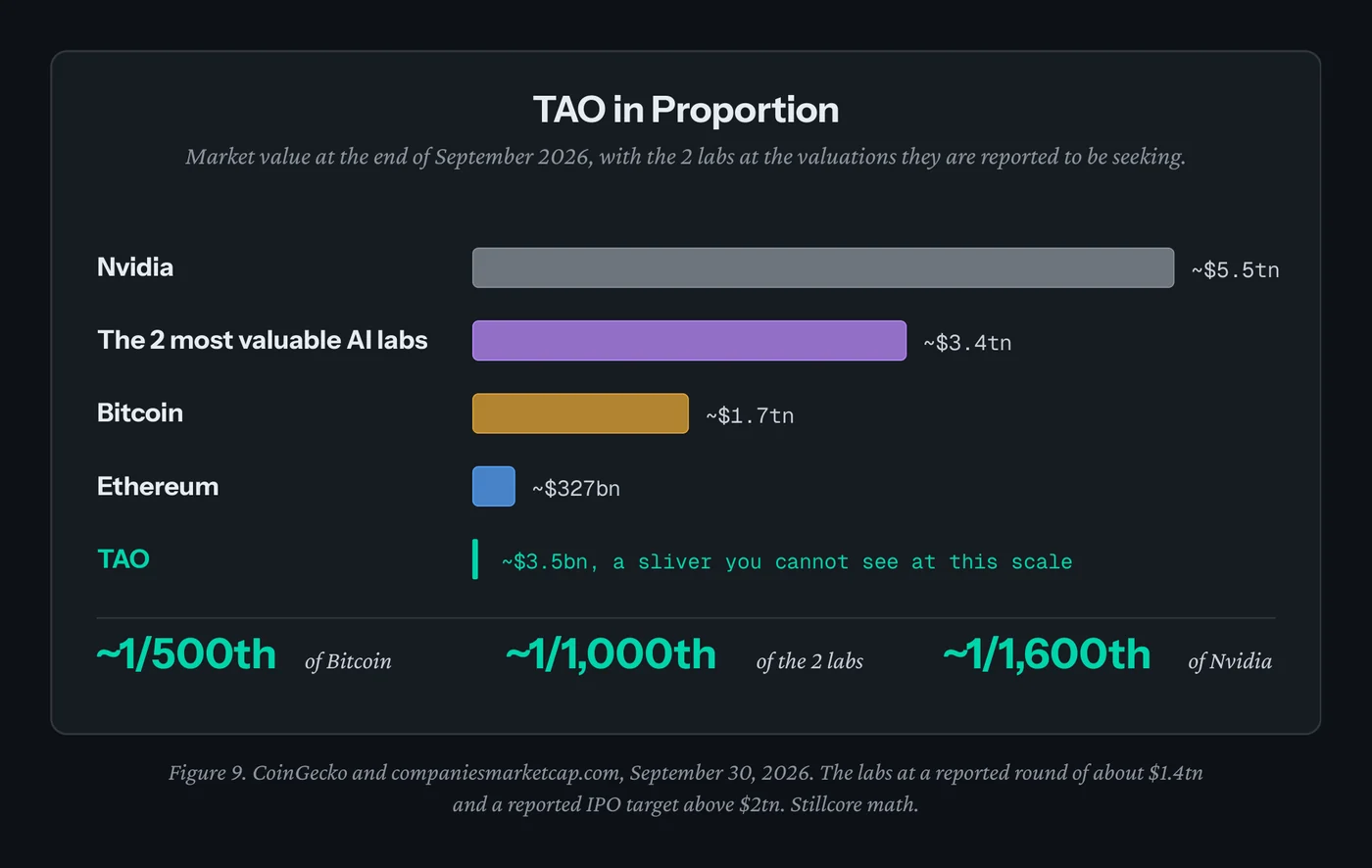
In what follows, “the Bittensor economy” means TAO plus the subnet tokens priced in it. On that measure the economy is worth about $5bn today (TAO’s $3.5bn and about $1.4bn of subnet tokens, which overlap somewhat, since the TAO in subnet pools backs the subnet tokens’ prices), so $1tn is 200 times the current figure. The first two methods below value the whole economy. The last two value TAO alone, so they imply a total above $1tn, which is what the plus sign in our title refers to. Read all four as pictures of what would have to be true.
The most direct method adds up the subnets, and power laws make it less far-fetched than it sounds. Suppose the network hosts 250 subnets of consequence by 2030, about the number of slots already on its roadmap. If 10 category leaders in areas like inference, compute, training and storage are worth $40bn each, 40 established subnets $10bn each and the other 200 $1bn each, the total is $1tn. No subnet in that picture becomes the biggest company in its category, and the median subnet is worth about what a typical unicorn is worth today, a valuation more than 1,000 private companies carry now. For reference, the largest subnet token today is worth about $140mm, and the 10 largest about $700mm together, so the stretch is at the top. The leaders would need to grow roughly 570 times, more than the headline multiple, which is one reason we don’t lean on this method alone.
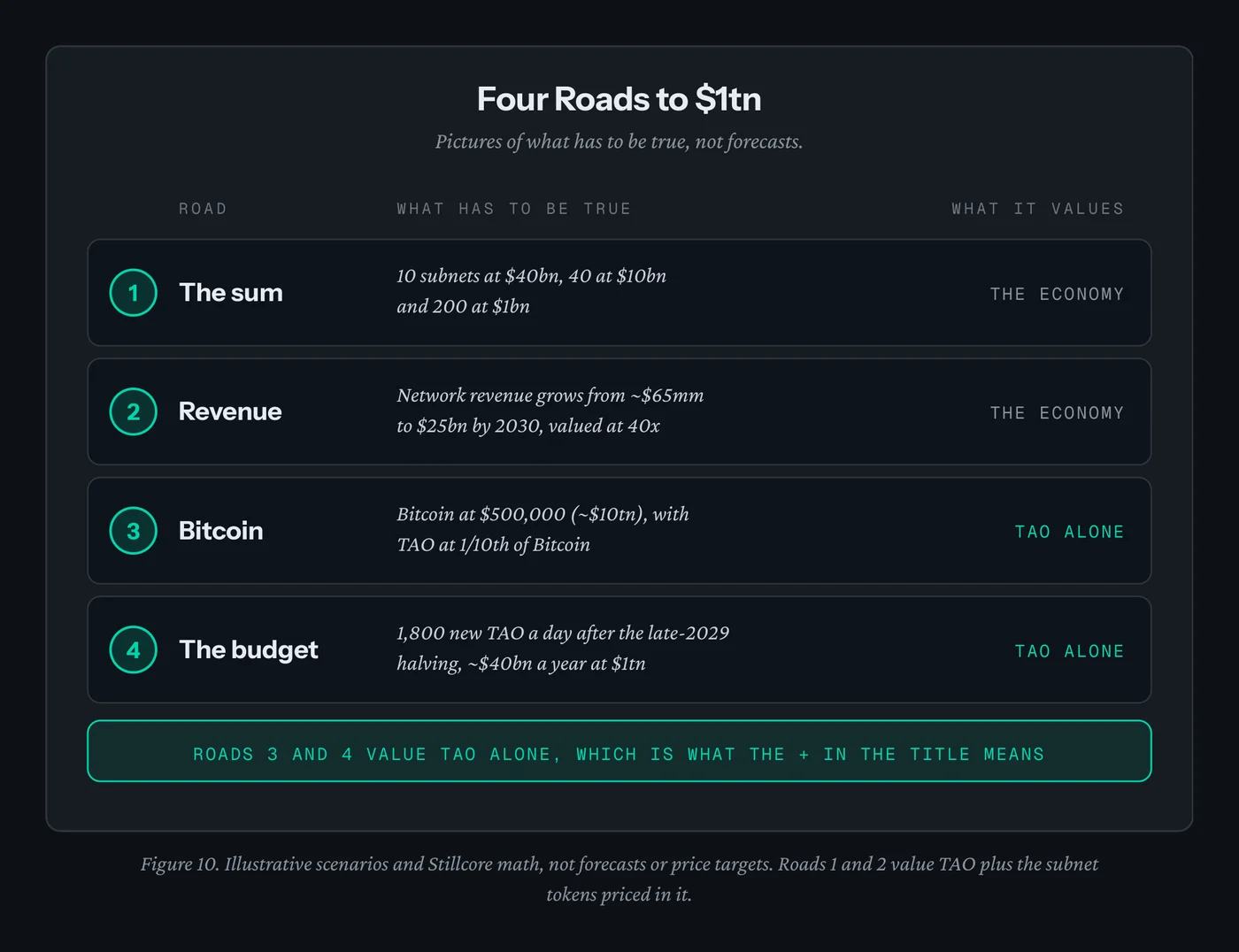
Revenue is a harder test, and the one we’d weight most. If network revenue grows from about $65mm now to $25bn by the end of 2030 and the market pays 40 times revenue, the network is worth $1tn. That means roughly quadrupling revenue every year between now and the end of 2030, about 385 times in all. The checkpoints would be about $375mm at the end of 2027, $1.5bn at the end of 2028 and $6bn at the end of 2029, and at 20 times revenue the 2030 requirement doubles to $50bn. Amazon Web Services reported $25.7bn of revenue in 2018, 12 years after it launched, into a cloud market much smaller than the market for intelligence is likely to be in 2030.
The Bitcoin comparison is simpler. At $500,000 a coin Bitcoin would be worth about $10tn, and TAO at 1/10th of Bitcoin would be worth $1tn. At $250,000, TAO would need to be 1/5th of Bitcoin, which is about where Ethereum sits today. Over the last decade Ethereum has been worth anywhere from about 4% of Bitcoin to nearly 80% at its 2017 peak. TAO is worth 1/500th, and we think a network that pays for the world’s intelligence won’t stay there.
The last calculation runs backward from the valuation to what it would pay for. If TAO alone were worth $1tn in 2030, after the second halving, each day’s 1,800 new TAO would be worth about $110mm, or roughly $40bn a year, a little less than the $43.9bn Meta spent on research and development in 2024. The market would hand out that budget every day to whoever produced the best intelligence, with no hiring process and no headquarters, and it’s the budget that pays for the machine in Section 05.
Four years is a short time for a gain of 200 to 290 times. The nearest precedent is Ethereum, the last asset to play the role TAO plays now, which was worth under $2bn at its 2016 peak and about $570bn at its November 2021 high, roughly 300 times in five and a half years, and which fell more than 90% along the way. TAO would need a similar multiple in less time. We don’t expect a straight line, and a drawdown of that size before 2030 wouldn’t, on its own, make us think the case was wrong.
We read TAO’s place in its life on three clocks, and they point to three different years. On the money clock it’s 2013. Bitcoin’s first halving came on November 28, 2012, which made 2013 its first full year after one, and TAO’s came in December 2025. Bitcoin began 2013 worth under $1bn and ended it near $9bn, and TAO’s $3.5bn sits inside that range. On the innovation clock it’s 2016, the year Ethereum’s first real applications appeared and a year before the rush of new projects that defined the next cycle. On the capability clock it’s 1997, the year Amazon went public and sold $148mm of goods, up from $15.7mm the year before, with almost the entire build-out of the web still ahead of it.
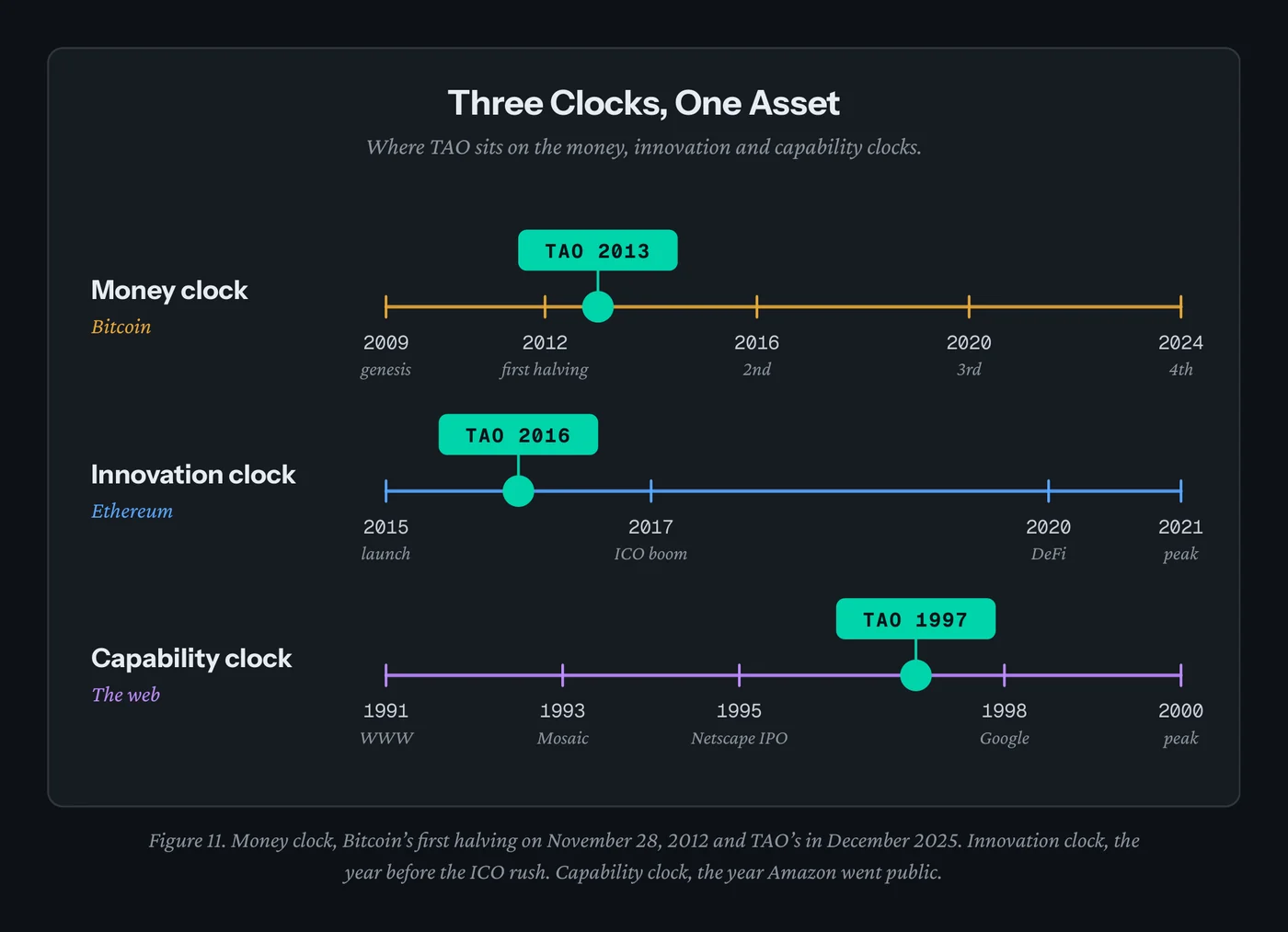
TAO is still priced at the speed of Bitcoin, and built at the speed of AI. AI is already in a supercycle, and we believe crypto is entering one. We think productivity takes center stage in 2027, and that by 2028 AI will be driving a full-scale revolution in how work gets done. Abundance on that scale is deflationary. Elon Musk has argued that when AI and robots grow the output of goods and services faster than the money supply, the problem becomes deflation rather than inflation, which would give central banks room to cut.
11. What Has to Be True
The biggest risk is that revenue grows too slowly. Even in our $1tn case, a year of issuance in 2030 could be worth up to about $40bn against $25bn of revenue, which means the subsidy is still bigger than the business it pays for. We can live with that, because the subsidy only has to shrink relative to revenue each year, and the third halving, which on the current schedule comes around 2033, halves it again. But if revenue lags the halvings, miners earn less and the machine in Section 05 ends up smaller than Figure 6 implies.
Jacob Steeves, the co-founder known as Const, still sets much of the chain’s rulebook, including its incentive parameters and upgrade path, and that concentration is key-person risk. This year the protocol stopped minting free tokens to subnet owners at registration, tied ownership of mature subnets to locked stake and merged the first pieces of on-chain governance, though upgrades still pass through a small multisig. In June Const published a plan to hand the rulebook to the network within about 18 months, by around the end of 2027, and at Exploit he said he had taken a heavy-handed role over the past six months and wants the network ready to run without him. We intend to hold the network to that plan.
If decentralized training never closes the gap, the closed labs keep the highest-value work and Bittensor serves the rest. That would lower the ceiling on the first two methods in Section 10 without ruling them out, since compute and inference already produce most of the network’s revenue.
The SEC decides when U.S. exchange-traded products come to market, and regulators could decide that some subnet tokens are securities, which would limit how they trade in the United States. In September the SEC’s staff said a token buyback isn’t the kind of managerial effort that makes a token a security when the network is functional and has no central party. Whether a subnet with a known team fits that description is a question for counsel, and the answer will shape how subnet tokens trade here. Kimi K3’s release in July also revived talk in Washington of restricting Chinese open models, so the politics of open weights are far from settled.
TAO still trades with Bitcoin’s four-year cycle. If the pattern holds, Bitcoin’s next halving in 2028 puts the cycle’s likely peak around 2029, and the year after every past peak has been rough on crypto assets. We expect at least one severe drawdown before 2030, and readers should plan on one too.
Dynamic TAO launched in 2025, and its pools and emissions logic have been rebuilt more than once since. Software this new carries risks that a protocol with a decade behind it doesn’t, and because every subnet runs on the same pool mechanism, a failure there would hit all of them at once.
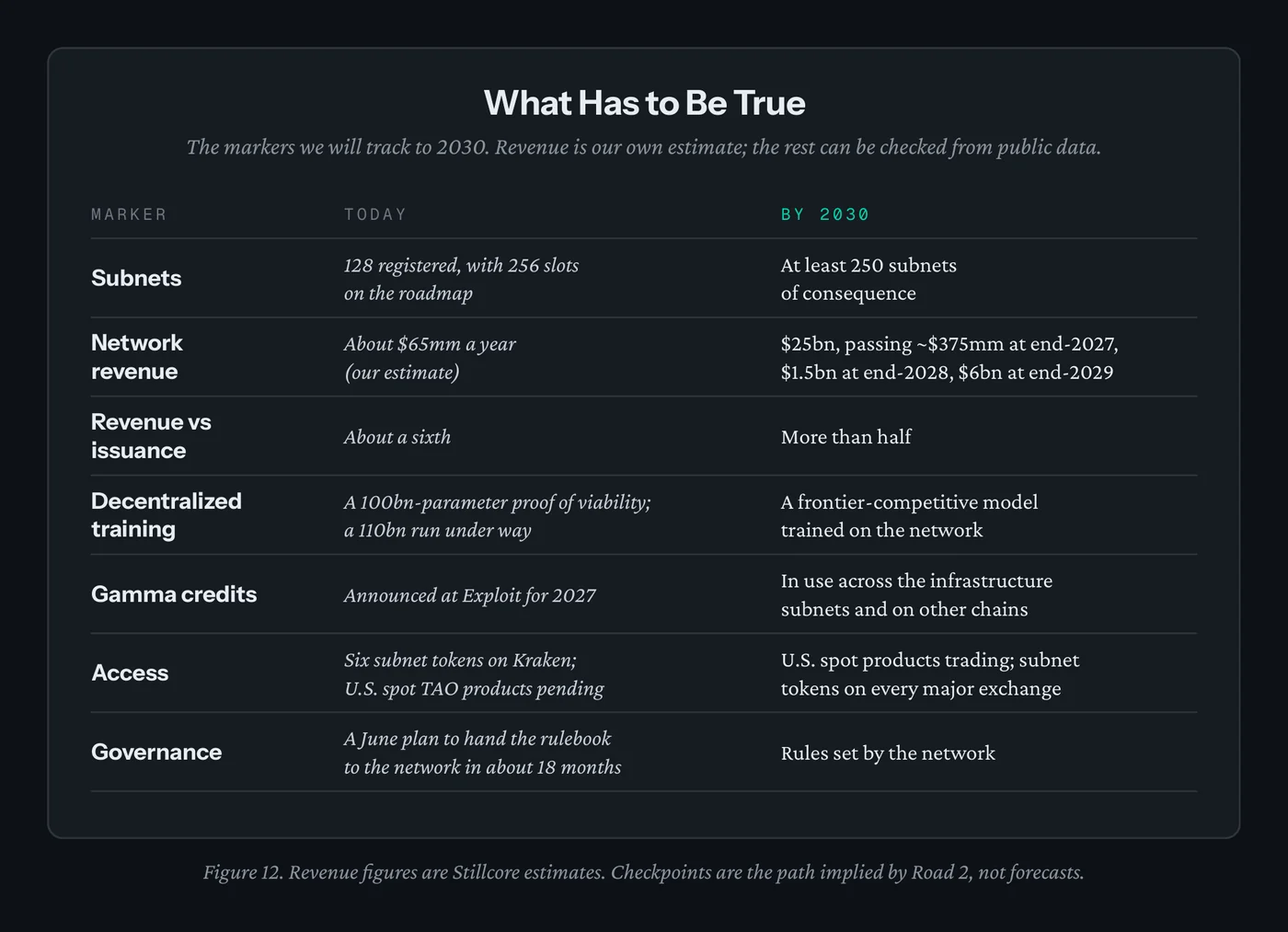
Here are the markers we’ll track between now and 2030. Revenue, which is still mostly paid off-chain, is our own estimate, and the rest can be checked from public data.
The Way
The epigraph compares the Tao to the great rivers and seas that the streams from the valleys run into. We picked it partly for the pun and partly because it describes how Bittensor is wired. Every subnet trades against one asset, so value created anywhere on the network, whether by a subnet buying and burning its own tokens or by a better model, ends up running downhill into the same pool of TAO.
Underneath the numbers, this paper is about who will own intelligence, the most important economic question of our lifetimes. For most of AI’s short history the answer has been a handful of companies, and the public argument has been over how much of their earnings they should be made to share. Bittensor gives the only answer we know of in which anyone can own a share. The people and machines that produce intelligence on the network own part of it through the tokens they earn, and anyone can take a share of the whole by holding TAO.
Our funds concentrate on subnets because on Bittensor the winners aren’t known in advance, and the market picks them every day. None of us has held a view with more conviction in our careers, though we may be early. We’ve written down what has to be true, and we intend to report against it each year until 2030.
Our earlier research, including The Bittensor Thesis and our State of Subnets report, is on this site. Accredited investors who want to go deeper can book a call.
Stillcore Capital, its principals and the funds it manages hold TAO and positions in subnet tokens, including some of the subnets named in this paper, and may buy or sell any of them at any time without notice. This paper is not investment advice and is not an offer to sell, or a solicitation of an offer to buy, any security. Interests in the funds are offered only to verified accredited investors, and only through the funds’ confidential offering documents. Full disclaimers are on our disclosures page.
Sources
- CoinGecko, Market data for TAO, Bitcoin and Ethereum, including TAO’s all-time high of $757.60 on March 7, 2024, accessed September 30, 2026 coingecko.com/en/coins/bittensor
- companiesmarketcap.com, Market capitalization of Nvidia, accessed September 30, 2026 companiesmarketcap.com/nvidia/marketcap
- TechCrunch, Report that OpenAI is in talks to raise at a valuation of about $1.4tn, September 29, 2026 techcrunch.com/2026/09/29/openai-repotedly-in-talks-to-raise-30b-round-at-1-4t-valuation
- Fortune, Report on a leading private AI lab’s planned IPO at a valuation above $2tn, September 29, 2026
- Stillcore Capital, “2026 State of TAO” (January 2026), “The Bittensor Thesis” (March 2026), “The Show Goes On” (April 2026) and “State of Subnets” (July 2026) stillcorecapital.com
- Epoch AI, “The plunging price of thought,” on the price of a given level of performance falling about 13x a year since 2023, September 22, 2026 epoch.ai/publications/the-plunging-price-of-thought
- Epoch AI, “LLM inference prices have fallen rapidly but unequally across tasks” (9x to 900x a year), March 12, 2025 epoch.ai/data-insights/llm-inference-price-trends
- Epoch AI, Open-weight models trailing the frontier by about four months in 2026, May 29, 2026 epoch.ai/data-insights/open-closed-eci-gap
- Epoch AI, Open models matching closed ones with about a one-year lag, November 4, 2024 epoch.ai/publications/open-models-report
- Vercel, AI Gateway Production Index, September 2026 (open-weight share of tokens and of estimated spending; August price per token), September 17, 2026 vercel.com/blog/ai-gateway-production-index-september-2026
- Vercel, AI Gateway Production Index, August 2026 (price decline driven by model mix), August 2026 vercel.com/blog/deepseek-overtakes-google-on-volume-cost-per-token-falls
- The Hacker News, Report of a U.S. lab’s allegation that seven China-based labs distilled its models, September 11, 2026
- CNBC, Squawk Box, Jensen Huang on distillation and competition, September 28, 2026 youtube.com/watch?v=DPpaPybxmkY
- Quartz, Jensen Huang on AI distillation, “That’s called competition”, September 28, 2026 qz.com/jensen-huang-ai-distillation-competition-white-house-092826
- Epoch AI and Ipsos, Near-daily AI use by U.S. adults rising from 8% to 19%, September 14, 2026 epoch.ai/data-insights/near-daily-ai-use-doubled
- All-In podcast, Jason Calacanis on untracked “dark” open-source tokens, September 25, 2026 youtube.com/watch?v=cvP_1jmnkmM
- William Stanley Jevons, “The Coal Question”, 1865
- Incunabula Short Title Catalogue (British Library), Census of editions printed before 1501 data.cerl.org/istc
- Aashish Velkar, London School of Economics, Economic History Working Paper 145/10, on wheat grading at the Chicago Board of Trade from 1856, 2010 lse.ac.uk/asset-library/information/wp145.pdf
- Joseph Santos, EH.Net Encyclopedia, “A History of Futures Trading in the United States” (Chicago Board of Trade futures, 1865) eh.net/encyclopedia/a-history-of-futures-trading-in-the-united-states
- Morgan Stanley TMT Conference, Jensen Huang on AI factories, tokens per watt and tokens per dollar, March 18, 2026
- Benzinga, AOL’s peak market value and Verizon’s $4.4bn purchase in 2015, May 28, 2019
- Oracle and Sun Microsystems, “Oracle to Buy Sun” for about $7.4bn, April 20, 2009 sec.gov/Archives/edgar/data/0000709519/000119312509082650/dex991.htm
- companiesmarketcap.com, Sun Microsystems’ market value history, including its 2000 peak, accessed September 30, 2026 companiesmarketcap.com
- National Law Review, A U.S. lab’s suspension of its two newest models after a Commerce Department export-control directive, June 17, 2026
- Vercel, AI Gateway Production Index, July 2026 (controls lifted June 30, access resumed July 1), July 2026 vercel.com/blog/ai-gateway-production-index-july-2026
- TechSpot, “Nvidia’s Jensen Huang joins X, defends Chinese AI,” on the “single point of failure” remark, Kimi K3’s ranking at launch and the reaction in Washington, July 24, 2026 techspot.com/news/113210-nvidia-jensen-huang-defends-chinese-ai-open-source.html
- NVIDIA, Form 8-K on its agreement to acquire Hugging Face, September 3, 2026 sec.gov/Archives/edgar/data/0001045810/000104581026000078/nvda-20260902.htm
- TechCrunch, “Nvidia confirms it will buy Hugging Face for $12.9 billion”, September 3, 2026 techcrunch.com/2026/09/03/nvidia-confirms-it-will-buy-hugging-face-for-12-9-billion
- Jacob Steeves (Const), “The State and Future of Bittensor,” opening talk at the Exploit Summit, Montreal, September 28, 2026 youtube.com/watch?v=G2GsHun38qM
- Jacob Steeves (Const), Thread on the Exploit announcements, including subnet usage figures and gamma tokens, September 29, 2026 x.com/const_reborn/status/2104904084054777917
- Stillcore Capital, Estimates of network revenue, September 2026 stillcorecapital.com
- Stillcore Capital, “State of Subnets,” on the first two subnets to earn enough to offset their miner emissions, July 2026 stillcorecapital.com
- Targon and Intel, “Decentralized Compute on Untrusted Hardware Using Intel TDX and Encrypted CVMs”, 2026 arxiv.org/abs/2607.21865
- Subtensor, Pull requests 2642 (“No initial owner alpha”), 2599 (“Convictions (stake locks)”) and 2781 (“Price-based emissions with miner-burn scaling”), May and June 2026 github.com/RaoFoundation/subtensor
- Lidin et al., “Covenant-72B,” arXiv 2603.08163, March 2026 arxiv.org/abs/2603.08163
- Macrocosmos, “Orion-100B: distributed pretraining”, June 1, 2026 macrocosmosai.substack.com/p/orion-100b-distributed-pretraining
- Macrocosmos, Post on Orion-100B as a viability proof, September 25, 2026 x.com/MacrocosmosAI/status/2103537520558661976
- Macrocosmos, Post on Orion-16B across mixed consumer and data-center GPUs, September 23, 2026 x.com/MacrocosmosAI/status/2102808976442458457
- Jacob Steeves (Const), Announcement of the Teutonic-II 110B training run, August 24, 2026 x.com/const_reborn/status/2091896286035235027
- Minos, Subnet repository, on storing data with Hippius, accessed September 30, 2026 github.com/minos-protocol/minos_subnet
- Engy, Verified inference for open models, accessed September 30, 2026 engy.ai
- Bittensor, Post describing gamma tokens as acquired by burning a subnet’s alpha, September 28, 2026 x.com/bittensor/status/2104680589731483992
- Exploit Summit, Keith Singery and Jacob Steeves, “Gamma Deep Dive”, September 29, 2026 x.com/ExploitSummit/status/2105006009462779958
- Eric S. Raymond, “The Cathedral and the Bazaar”, 1997
- Quanta Magazine, “AI Has Solved One of Math’s $1 Million Millennium Prize Problems”, September 8, 2026 quantamagazine.org/ai-has-solved-one-of-maths-1-million-millennium-prize-problems-20260908
- CoinDesk, Bitcoin’s seven-day average hashrate reaching 1 zettahash a second, September 2, 2025
- Cambridge Centre for Alternative Finance, Bitcoin’s electricity use compared with that of countries, August 31, 2023 ccaf.io/cbnsi/cbeci
- TechSpot, Mark Zuckerberg on compute of about 600,000 H100-equivalents by the end of 2024, January 20, 2024
- Actual, Local inference across users’ own machines, accessed September 30, 2026 actual.inc
- Ronald Coase, “The Nature of the Firm,” Economica, 1937
- Jack Dorsey and Roelof Botha, “From Hierarchy to Intelligence,” Block, March 31, 2026 block.xyz/inside/from-hierarchy-to-intelligence
- Fortune, “Jack Dorsey and Roelof Botha think AI can make middle management obsolete”, April 2, 2026 fortune.com/2026/04/02/jack-dorsey-roelof-botha-ai-middle-management
- Tom’s Hardware, OpenAI’s reported $300bn, five-year computing agreement with Oracle, citing the Wall Street Journal, September 11, 2025
- All-In Summit, Jensen Huang on closed models as “kind of like bottled water”, September 2026 youtube.com/@allin
- Jacob Steeves (Const), Exploit Summit opening talk, on the training pipeline across subnets and a subnet whose incentive mechanism is run by a model, September 28, 2026 youtube.com/watch?v=G2GsHun38qM
- TAOStats and the Bittensor chain, Issuance, root stake, subnet pools, subnet token values and the halving schedule, accessed September 30, 2026 taostats.io
- CoinGecko, Bittensor subnets category, market values of subnet tokens, accessed September 30, 2026 coingecko.com/en/categories/bittensor-subnets
- Mark Jeffrey, “State of TAO, A Bittensor Report (Excerpt),” on X, on TAO as the coin of the realm, February 19, 2026
- Blockonomi, “Wormhole launches canonical TAO on Solana network”, May 5, 2026 blockonomi.com/wormhole-launches-canonical-tao-on-solana-network
- OKX, “OKX to list TAO/USDT (Bittensor) for spot trading”, June 30, 2026 okx.com/en-us/help/okx-to-list-tao-usdt-bittensor-for-spot-trading
- Kraken, “Bittensor subnet tokens are coming to Kraken,” and Kraken’s subnet token markets against the dollar, 2026 blog.kraken.com/product/new-features/bittensor-subnet-tokens
- Grayscale Bittensor Trust, Registration statement on Form S-1 to list on NYSE Arca, December 30, 2025 sec.gov/cgi-bin/browse-edgar?action=getcompany&CIK=0002029297
- CB Insights, The Complete List of Unicorn Companies, accessed September 30, 2026 cbinsights.com/research-unicorn-companies
- Amazon.com, Inc., Fourth-quarter and full-year 2018 results (AWS net sales of $25,655mm), January 31, 2019 sec.gov/Archives/edgar/data/0001018724/000101872419000002/amzn-20181231xex991.htm
- Meta Platforms, Fourth-quarter and full-year 2024 results (research and development of $43,873mm), January 29, 2025 investor.atmeta.com
- CoinMarketCap, Ethereum and Bitcoin market value history, including Bitcoin’s value at the start and end of 2013, accessed September 30, 2026 coinmarketcap.com
- Amazon.com, Inc., Annual report on Form 10-K for 1997 (net sales of $147.8mm, against $15.7mm in 1996) sec.gov
- The Economist, Interview with Elon Musk, on AI, robots and deflation, July 29, 2026 economist.com
- Crypto Briefing, Const’s roadmap to decentralize Bittensor within 18 months, June 22, 2026 cryptobriefing.com/bittensor-decentralization-roadmap-18-months
- Subtensor, Pull request 2198, on-chain governance, June 9, 2026 github.com/RaoFoundation/subtensor/pull/2198
- Unchained, “SEC staff narrow token buyback guidance to networks with no central party”, September 29, 2026 unchainedcrypto.com/sec-staff-narrow-token-buyback-guidance-to-networks-with-no-central-party